State Lines Don't Exist on the Blockchain — Until They Do: A Field Guide to the Geo-Fence Around Your Bankroll
Here's the pitch that gets sold to every American crypto bettor: the blockchain doesn't know you're from Ohio. It doesn't care that you're in Texas, Florida, or somewhere in the middle of Nebraska where the closest legal sportsbook is a two-hour drive and a moral crisis away. Your wallet is a wallet. The odds are the odds. Bet at 3 A.M. if you want.
And then, one morning, you log in and there's a banner: "We regret to inform you that we can no longer serve customers in your jurisdiction."
That's the moment the fantasy dies. The chain didn't stop you — the geo-fence did.
The Map Nobody Shows You
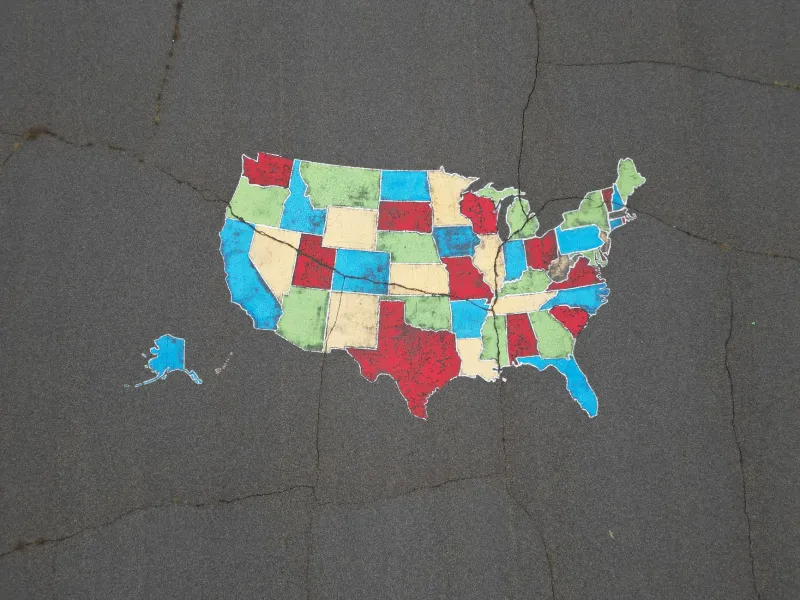
The legal landscape for online betting in the US is a patchwork quilt stitched by fifty different legislatures, and crypto books sit in the gray space between them. A handful of states have fully regulated markets. Others have legalized sports betting but not online casinos. A few treat unlicensed offshore wagering as a gray zone that regulators grumble about but rarely prosecute — for the bettor, at least.
What this means in practice: two bettors using the same crypto book, same odds, same coins, are having completely different legal experiences depending on which side of a state line they're parked on. The blockchain doesn't enforce any of it. The book's compliance department does.
And that compliance department is where your problem starts.
Geo-Blocking vs. the Chain: A Losing Fight
Traditional offshore books geo-block by IP address. Crypto-native operations have a harder time hiding behind that, because every deposit and withdrawal is a permanent, timestamped, publicly visible record. If your wallet has a history — DeFi positions, NFT mints, airdrops that trace back to US-based protocols — your on-chain footprint can paint a picture of where you actually live, no VPN required.
Some books lean into this. Wallet screening, cluster analysis, exchange-linked address tagging — the same tools used to catch sanctions evaders can be pointed at bettors. The result is a weird inversion: the technology that promised anonymity is the thing that documents you best.
A VPN gets you past the front door. It does nothing about the fact that you cashed out to an exchange account that knows your name, your SSN, and your state.
When the Door Slams Shut Mid-Season
Here's the scenario that should keep gray-market bettors up at night — more than any bad beat:
- You've been betting on a book for months. Bankroll's up. Season's rolling.
- The book announces a jurisdiction change — a regulatory crackdown, a licensing pivot, a compliance audit, or just cold feet.
- Your state is on the exclusion list.
- Now what?
The good versions of this story: you get a withdrawal window, you pull your funds, you grumble and move on. The bad versions: your balance gets frozen pending "verification," and verification includes questions you can't answer truthfully without confirming you were in a restricted state the whole time.
Your funds are on-chain, sure. But they're in the book's custody, on the book's terms. Self-custody only counts when the money's actually in your pocket.
The Practical Playbook
Nobody's telling you how to live your life. But if you're going to operate in the gray, operate smart:
- Withdraw early, withdraw often. A balance sitting on a book is a balance exposed to its jurisdiction decisions, its solvency, and its whims. Treat the book like a vending machine, not a bank.
- Keep your on-chain identity boring. The wallet you bet with shouldn't be the wallet that's publicly linked to your whole financial life.
- Read the terms before you need them. Specifically, search for "jurisdiction," "restrictions," and "forfeiture." If a book reserves the right to void balances from restricted states, understand that clause is aimed at you.
- Assume the rules can change overnight. Because they can, and they have, and the bettors who got hurt were the ones who assumed yesterday's rules were permanent.
The Uncomfortable Truth
The pitch of borderless crypto betting is half right. The rails really are global. The odds really don't check your ID. But the institutions sitting on top of the rails — the books, the exchanges, the regulators circling overhead — live entirely in the world of state lines.
The chain doesn't care where you live. The book does. The exchange does. And eventually, if you're not careful, you'll find out exactly how much they care — right around the time your balance does.
Bet sharp. Keep your funds close. And never mistake a borderless blockchain for a borderless industry.